

Concrete Loading Dock Ramps vs. Portable Steel: Which Saves You More in the Long Run?

For warehouses, distribution centers, and facilities with loading docks, the question often arises: Should we invest in a concrete loading dock ramp or purchase a portable steel yard ramp?
At first glance, a concrete ramp may seem like a permanent, one-time solution. But when you look deeper—factoring in costs, flexibility, downtime, and long-term ROI—a portable or permanent steel loading dock ramp often proves to be the smarter investment.
In this guide, we’ll compare concrete loading dock ramps (cast-in-place and precast) with portable steel yard ramps, exploring cost, installation, maintenance, and long-term savings.
The Appeal of Concrete Ramps

Concrete ramps have been a traditional solution for decades. Businesses often default to them because they appear permanent and durable. But there are trade-offs.
Types of Concrete Loading Ramps
- Cast-in-place concrete ramps: Built onsite with forms and poured concrete. They are fully customizable but require a longer construction time.
- Precast concrete ramps: Manufactured off-site in sections, delivered, and set into place. Faster than cast-in-place but limited in customization.
Concrete Loading Dock Ramp Costs
Cast-in-place: $25,000–$60,000+, depending on size, labor, site prep, and permitting.
Precast ramps: $20,000–$40,000+, plus transportation and crane costs for installation.
Beyond upfront costs, businesses must budget for:
- Engineering and permitting fees
- Excavation and grading
- Rebar reinforcement and drainage planning
Issues with Concrete Ramps
- Cracking and spalling from freeze-thaw cycles or heavy forklift traffic.
- Repairs are costly and disruptive, requiring concrete patching or full replacement.
- No flexibility—once it’s built, you can’t move it if your facility needs change.
The Case for Portable Steel Yard Ramps

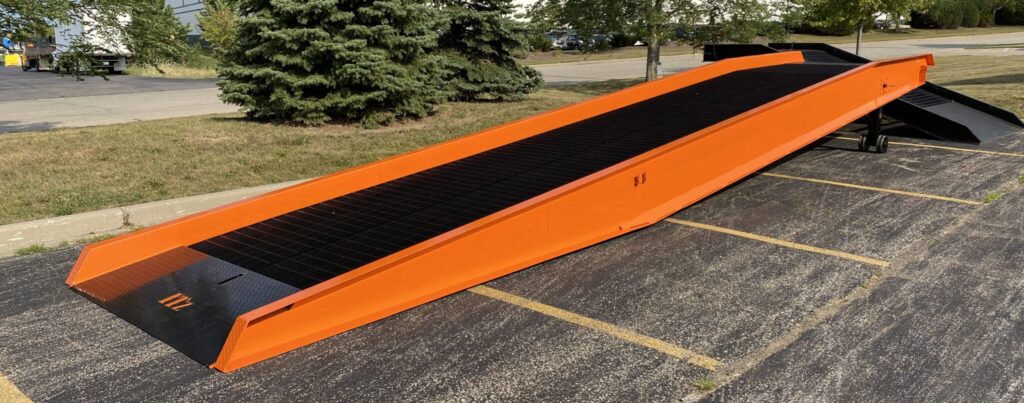
A portable steel yard ramp is a freestanding, movable ramp that allows forklifts or equipment to move from ground level into a truck bed or dock. HandiRamp specializes in heavy-duty steel ramps designed for long-term industrial use.
Cost of Steel Yard Ramps
New steel yard ramp: Around $14,500 (HandiRamp standard models).
Used yard ramps: $9,000–$10,000, depending on condition.
Rentals: $1,000 per month, perfect for seasonal or short-term needs.
Advantages Over Concrete
- Zero permitting required – deploy immediately without waiting on construction approvals.
- Installation in hours, not weeks – delivered, placed, and ready for use the same day.
- Flexibility – move it around your yard or between facilities as needs evolve.
- Resale value – steel ramps retain value and can be resold, unlike immovable concrete.
- Low maintenance – built from heavy-duty steel, designed to last decades with basic upkeep.
Concrete vs. Steel Yard Ramps: Side-by-Side Comparison
Factor | Concrete Ramp | Portable Steel Yard Ramp |
Upfront Cost | $20,000–$60,000+ | $14,500 new / $9,000–10,000 used / $1,0000 per month rental |
Installation Time | Weeks to months (construction, permits, inspections) | Same-day deployment |
Permitting | Required (structural, zoning, ADA in some cases) | None required |
Flexibility | Permanent, immovable | Portable, move between doors, facilities, or sites |
Maintenance | Cracking, spalling, patching | Minimal; steel holds up to heavy use |
Lifespan | 20–30 years (with repairs) | 15–20+ years, portable, resale potential |
Disruption | Construction impacts yard operations | None—ready immediately |
Resale Value | None | Yes—retain and resell when no longer needed |
👉 For businesses seeking long-term ROI and adaptability, portable steel yard ramps consistently come out ahead.
Practical Use Cases
Leased Facilities: Why spend $40,000 on a permanent ramp you can’t take with you when you move? A portable ramp travels with your business.
Seasonal Operations: Renting a ramp at $1,000/month for a 3-month busy season is far cheaper than pouring concrete.
Growing Businesses: As your dock needs expand, portable ramps can be added or relocated without major capital projects.
Temporary Loading Dock Solutions: Portable ramps function as instant docks during construction, expansions, or emergencies.
ROI Analysis: Concrete vs. Steel
Let’s break down the cost over a 10-year period:
Concrete Ramp:
- Upfront cost: $35,000 (average precast)
- Repairs: $1,000–$2,500 every few years for cracks/patches
- Total 10-year spend: ~$40,000+
- No resale value
Portable Steel Ramp:
- Upfront cost: $14,500 new / $9,500 used
- Minimal maintenance costs (paint touch-ups, grease)
- Resale value after 10 years: ~$5,000–7,000
- Total 10-year spend: ~$7,000–9,000 net
👉 Bottom line: A steel yard ramp can cost less than one-quarter of a concrete ramp over 10 years.
HandiRamp’s Portable Steel Ramps

At HandiRamp, we’ve been manufacturing portable steel yard ramps for decades, designed to handle the toughest industrial environments.
- Capacities up to 30,000 lbs for forklifts and heavy equipment.
- Lengths and widths are customizable for your dock or fleet.
- Grip surface decking prevents slips in wet or icy conditions.
- Towable options are available for moving ramps across large yards.
Whether you need a short-term rental or a permanent addition to your facility, HandiRamp has the expertise and inventory to match your business needs.
FAQ
What is the upfront cost?
Portable Steel Ramp: Upfront cost: $14,500 new / $9,500 used
What are the maintenance costs?
Minimal maintenance costs (paint touch-ups, grease)
What is the resale value after 10 years?
Resale value after 10 years: ~$5,000–7,000
What is the total 10-year spend?
Total 10-year spend: ~$7,000–9,000 net
Flexibility, Savings, and ROI: Steel Yard Ramps Come Out Ahead
Concrete ramps may look permanent, but in today’s fast-moving business environment, permanence is not always an advantage. With high upfront costs, long installation times, and no flexibility, concrete loading dock ramps can quickly become sunk costs.
In contrast, portable steel yard ramps from HandiRamp deliver immediate usability, lower lifetime costs, and adaptability to your business needs. Whether you’re a warehouse manager, fleet operator, or small business owner, a steel ramp saves you money and protects your flexibility in the long run.
👉 Ready to calculate your ROI? Call us at 800-876-7267 today to explore purchase, used, or rental options for our heavy-duty portable steel yard ramps.